Cutting Through The Noise Of Financial Markets



Where Will Gold Head From Here?
Context: If you’ve been sitting on a dusty old treasure chest buried under your backyard, now might be the time to crack it open. Forget pirate maps even a metal detector at the beach could be your ticket to riches. Over the past several weeks, gold has not only made its way into the financial pages but has dominated the headlines across virtually every major news outlet, becoming the focal point of conversations among investors, analysts, and everyday savers alike. Its remarkable run has sparked debates ranging from central bank policy to geopolitical uncertainty, and while the excitement is undeniable, the more pressing issue now is not simply acknowledging its current shine but asking the harder question: how much further can this rally realistically go, and what path might gold take as global markets continue to shift?
Technical Story
Since the start of 2024, gold has been on a remarkable run surging over 100% as of October 27th. As is often the case, once “every man and their dog” wants a bar and gold dominates financial headlines, a sharp correction follows. That’s exactly what happened: gold experienced its worst week in over a decade, pulling back roughly 8% from its freshly minted all-time highs.
But what’s really driving this rally?
The U.S. Factor
Volatility in the U.S. under President Trump has shaken global confidence in the dollar, particularly among developing nations that have opted to heavily increase positions in gold. One day, headlines warn of an all-out trade war; the next, a “constructive” meeting between Trump and Xi is announced. This inconsistency has made the dollar less appealing to those seeking stability.
Trump has repeatedly emphasised America’s long-standing trade deficit. (See Figure 1: U.S. Trade Balance Over the Last Decade.) His push to revive domestic industry is arguably supported by a weaker dollar. A strong USD makes it harder for U.S. manufacturers to compete globally, so a depreciating dollar could be seen as a strategic advantage.
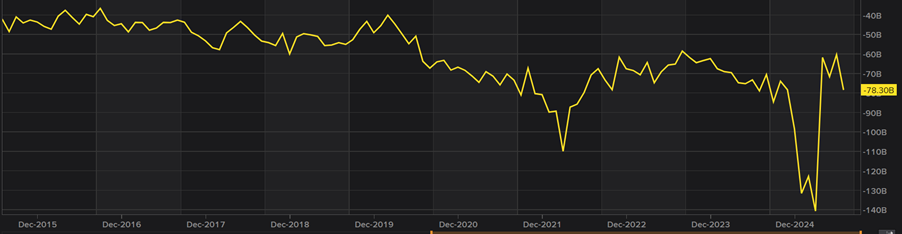
This context helps explain Trump’s frequent clashes with Fed Chair Jerome Powell. Trump has criticized Powell for not cutting interest rates fast enough, favouring a more aggressive approach to monetary easing. Lower rates would reduce the dollar’s yield, making it less attractive to global investors and potentially boosting U.S. exports.
In this environment, gold has become a favoured hedge. From retail investors to central banks, many are turning to gold as a store of value amid dollar uncertainty.
The Role of Quantitative Easing
Quantitative easing (QE) is a monetary policy tool where central banks purchase financial assets like government bonds to inject liquidity into the economy and lower borrowing costs. Japan has long used QE to stimulate its sluggish economy, contributing to its high debt-to-GDP ratio and poor performance of Japanese Yen.
During the COVID-19 pandemic, nearly every major central bank adopted QE to support government spending and stabilise markets. This had two major effects that fuelled gold’s rise:
- Global Debt Surge: Government debt levels soared in unison, reigniting investor concerns about long-term fiscal sustainability. Gold, as a non-yielding but stable asset, became more attractive as a hedge against sovereign risk.
- Currency Debasement Fears: QE reminded investors that governments can print money at will. While stimulus efforts helped many households especially in countries like Australia the long-term implications raised red flags. Inflation in everyday goods and a perceived erosion of currency value pushed more investors toward gold.
Interest Rate Outlook
After a period of monetary tightening in 2022 and 2023, many governments were expected to begin cutting interest rates in late 2024 and into early 2025. These anticipated reductions lowered the opportunity cost of holding gold an asset that doesn’t produce income but has historically performed well in low-yield environments. As rates began to fall, gold became increasingly appealing to investors seeking stability and long-term value.
The million dollar question, where will it go?
Looking at historical patterns, it’s reasonable to expect a quieter period ahead. After gold’s strong run from 2009 to 2012, momentum slowed significantly, and we saw a similar deceleration following the 2019–2020 rally. However, the current cycle is underpinned by a new mindset the so-called “debasement trade” which could sustain momentum for another 12 months, at least until governments can formulate credible plans to address the elevated debt-to-GDP ratios accumulated during the COVID era.
There’s growing concern among institutional investors that governments may eventually resort to reckless money printing to manage their debt burdens. This would erode the purchasing power of fiat currencies, making them less attractive and further fuelling demand for alternative stores of value. While some investors view gold’s recent pullback as a buying opportunity, it’s unlikely that its performance will continue at the same pace seen over the past few years especially now that it faces competition from its “liquid gold” counterpart, Bitcoin. Since its inception, Bitcoin has consistently attracted investor interest and will likely continue to gain traction, provided its ecosystem remains stable and operational.
Overall, I maintain a neutral rating on gold. While I don’t believe it can sustain the extraordinary momentum it has shown in recent years, that doesn’t mean it won’t continue to deliver positive returns. What’s more important is the broader message behind gold’s rally: a growing recognition of the immense challenge governments face in managing debt levels that, in many cases, appear virtually unpayable.
We’re witnessing a genuine behavioural shift among investors, driven by deepening concerns over fiat currencies. This shift could accelerate the integration of gold and cryptocurrencies into mainstream financial markets and global economies faster than many anticipate. Although neither asset generates yield, the traditional opportunity cost of holding them is increasingly being outweighed by a more pressing concern: they are not subject to the discretionary control of central banks, whose actions particularly in recent years have come under intense scrutiny.
Disclaimer: The content provided on Whisper Wealth is for informational and educational purposes only and does not constitute financial, investment, or legal advice. While I strive to provide accurate and timely information, I am not a licensed financial advisor, and the views expressed are my own. You should not rely solely on this content to make financial decisions. Always consult with a qualified financial professional before making investment choices. Whisper Wealth and its contributors are not responsible for any losses or damages resulting from reliance on this information.


