Cutting Through The Noise Of Financial Markets



Japan’s Equity Market: From Lost Decades to Renewed Momentum
Context: Japan has struggled for years under the weight of persistent deflationary pressures that proved difficult to shake off. Decades of aggressive quantitative easing have left the country with a towering debt‑to‑GDP ratio, raising concerns about long‑term sustainability. Now, however, a turning point appears to be emerging: bond yields are rising as Japan seeks to move beyond its “lost decades.” The pressing question is whether the nation can manage the burden of higher repayments on such an enormous debt load.
Historical Performance
For decades, Japan’s equity market was overshadowed by what became known as the “lost decades.” Beginning in the early 1990s, the collapse of a massive asset bubble triggered sharp declines in property and stock market values. Easy credit and loose monetary policy in the years leading up to the crash had fuelled speculative excess, but when the bubble burst, the fallout was severe. Non-performing loans surged, crippling the banking sector and undermining financial stability. Persistent deflationary pressures kept interest rates anchored at –0.1% for nearly a decade, eroding growth and investor confidence. Ineffective government stimulus measures and mounting demographic challenges from a shrinking population further compounded the stagnation. The result was a prolonged period of economic weakness and deflation that defined Japan’s lost decades.
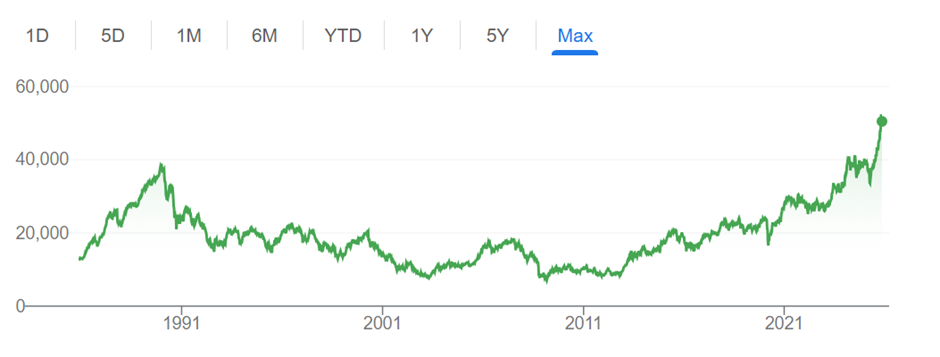
Figure 1. Performance of the Nikkei 225 since 1985. For more than two decades from 1990 through 2012 the Nikkei 225 remained in a downtrend, an exceptionally rare bearish run for a developed market.
Where Are We Now?
That narrative began to shift in March 2024, when the Bank of Japan (BOJ) implemented its first rate hike in nearly two decades, ending the world’s last negative interest rate regime. Since then, momentum has steadily built, particularly over the past six months, propelling the Nikkei 225 beyond its all-time high from the 1990s. Investors have interpreted the BOJ’s gradual tightening path as a signal that policymakers believe the economy is strengthening without overheating.
Despite lingering supply-side inflationary pressures, a combination of declining unemployment now at 2.6% and wage growth of 5.46%, the highest since 1991, has reinforced confidence in the BOJ’s cautious approach. This backdrop has encouraged investors to bet on a more optimistic outlook for Japan’s equity market.
The bond market will remain a key indicator of Japan’s trajectory. To keep rates low and demand strong for government debt, the BOJ has long been a dominant buyer through its quantitative easing program. As the central bank gradually reduces its holdings, yields are expected to climb. A mix of market optimism and the BOJ’s retreat from heavy bond purchases could push yields toward 2% early next year. Rising yields would signal growing confidence that the economy can stand on its own, with less need for direct government support a positive sign for equity investors.
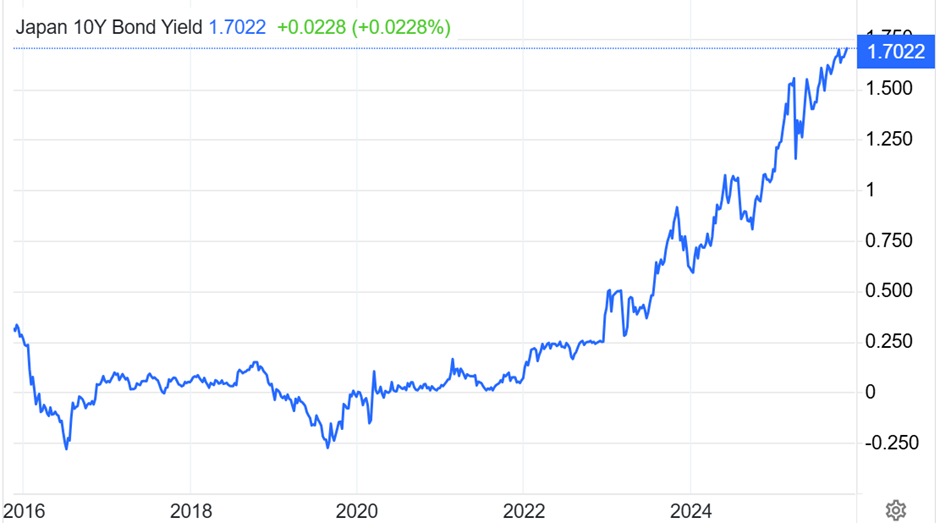
Figure 2. Displays the historical yields for 10 year Japanese Government Debt.
Domestic Demand Returns
Japan has long been a global powerhouse in automobiles, robotics, and consumer electronics, with international demand sustaining growth even as domestic consumption stagnated. More recently, however, year-to-date performance in sectors such as industrial services (+67%), communications (+54%), and utilities (+32.32%) has highlighted a resurgence in local demand.
This renewed strength is a positive signal for equity markets, suggesting investors are now willing to assign higher multiples to sectors that had previously been dormant. Coupled with rising earnings, this shift could pave the way for a sustained bullish run in select areas of Japan’s market over the coming years.
Finance Sector
Net interest margins were severely compressed during the era of negative interest rates, leaving banks with little room to generate returns on traditional lending. With the policy rate now lifted to 0.5%, institutions have regained breathing space, allowing them to expand margins and improve profitability. This shift not only strengthens balance sheets but also enhances the sector’s ability to support credit growth, positioning banks more favorably in a gradually normalising interest rate environment.
Where Do We Go From Here?
Japan’s economy is projected to see modest expansion in the coming years, with GDP growth expected to hover around 0.5%. Declining unemployment and a gradual path of rate hikes should reassure investors that the recovery is continuing without overheating.
That said, Japan still faces structural headwinds: an exceptionally high debt-to-GDP ratio after years of quantitative easing, and a population that is set to keep shrinking for the foreseeable future. On the positive side, ongoing reforms in public company governance are designed to attract foreign capital, improve profitability, and enhance transparency developments that benefit shareholders across the board.
The Nikkei 225 currently trades at 17.6x earnings, slightly above its long-term average, suggesting valuations are elevated as investors have already priced in near-term growth expectations.
Conclusion
Overall, Japan’s outlook remains cautiously optimistic. As long as renewed deflationary pressures are avoided, the equity market is likely to deliver moderate performance over the next few years, with much of the near-term growth already reflected in current valuations. After decades of stagnation, Japan now has the chance to move beyond the legacy of its “lost decades” and re-establish itself as a market defined by both global competitiveness and revitalised domestic demand.
Disclaimer: The content provided on Whisper Wealth is for informational and educational purposes only and does not constitute financial, investment, or legal advice. While I strive to provide accurate and timely information, I am not a licensed financial advisor, and the views expressed are my own. You should not rely solely on this content to make financial decisions. Always consult with a qualified financial professional before making investment choices. Whisper Wealth and its contributors are not responsible for any losses or damages resulting from reliance on this information.


