Cutting Through The Noise Of Financial Markets



Can the Russell 2000 Become a Safe Haven in an AI-Dominated Market?
Context: Since the post‑COVID period, the Russell 2000 has struggled, weighed down by the challenges of a high‑rate, tight monetary policy environment conditions in which the index has historically underperformed. In this piece, we explore the factors behind that weakness and consider why the next easing cycle could offer much‑needed relief and renewed momentum for small‑cap equities.
Post Covid Struggles
In a world dominated by AI hype and speculation, investors are beginning to ask whether the Russell 2000 could emerge as a safe haven once the larger companies those that have exceeded expectations for years inevitably slow down.
Historically, the Russell has struggled in high interest rate environments, a trend that has been especially evident in the U.S. since the post-COVID era. Small-cap companies are more vulnerable than their large-cap peers in the S&P 500 and Nasdaq, and there are several reasons why:
- Domestic Focus: Roughly 76% of revenue in the Russell 2000 comes from U.S. operations, far higher than other indexes. When interest rates rise, consumer spending tightens, and this reliance on domestic demand hurts small caps disproportionately.
- Higher Reliance on Debt: Small-cap firms often depend on bank loans and short-term financing. Elevated interest rates increase borrowing costs, squeeze margins, and limit growth investment.
- Weaker Pricing Power: Global giants like Apple and Google can pass higher costs onto consumers thanks to their competitive moats. Smaller companies rarely have that advantage, meaning inflation erodes margins rather than being offset by higher prices.
Why Offshore Exposure Has Helped Larger Indexes
While U.S. GDP growth is expected to remain modest around 1.6% this year and 1.5% next large-cap tech companies have continued to post strong results thanks to globally diversified income streams. Their balanced mix of international and domestic revenue has shielded them from weaker U.S. demand.
This has translated into stronger performance: Nasdaq +19.23% YTD, S&P 500 +14.75% YTD, and Russell 2000 +7.02% YTD. The Russell’s heavy reliance on domestic demand explains why it has lagged. Looking ahead, however, if tariffs don’t trigger stagflation and interest rates begin to ease, the next cycle could favor the Russell as U.S. demand recovers.
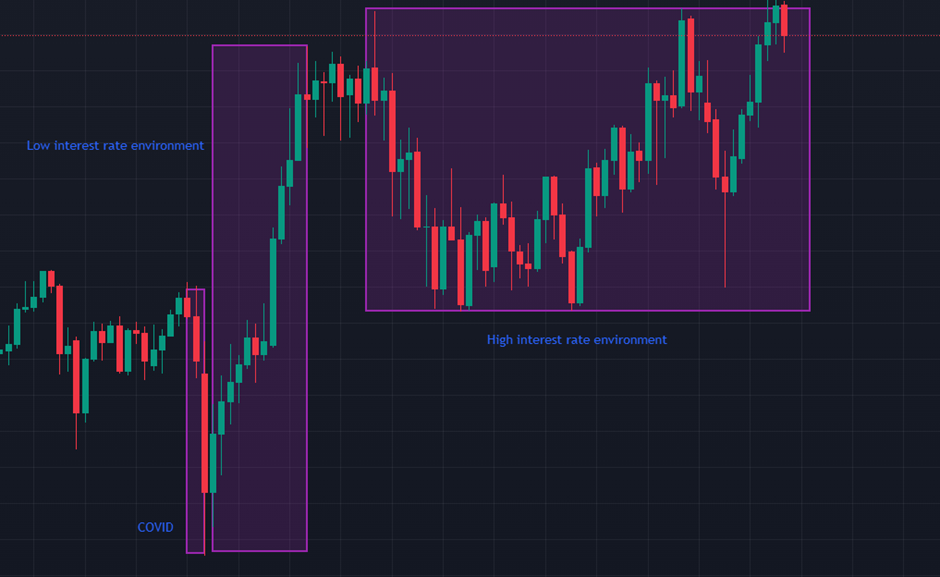
How the Russell Has Performed Post Covid
During the COVID crash, the Russell fell harder than larger indexes as investors fled riskier small caps. Yet its rebound was strong, supported by loose monetary policy and government stimulus that bolstered domestic demand.
Since then, however, the global cost-of-living crisis and persistently high interest rates have weighed heavily on small caps. Elevated borrowing costs have limited investment, while weaker domestic demand has kept performance subdued.
Looking forward, it seems reasonable to expect some relief. U.S. growth is unlikely to maintain its current trajectory with rates held at restrictive levels, and the Federal Reserve’s cautious easing cycle should eventually provide support. While 2026 may remain sluggish, 2027 could mark a turning point for the Russell as monetary conditions normalise.
Sector Analysis
Technology firms within the Russell 2000 are generally characterised by a heavy reliance on debt, reflected in elevated debt‑to‑equity ratios. Over the past several years, this has translated into higher repayment obligations, which in turn constrained capital expenditure. For many of these companies particularly those without established, widely recognised products limited reinvestment in core competencies has hindered their ability to attract investor attention. The anticipated easing cycle, however, should provide relief by lowering debt servicing costs and potentially restoring free cash flow. This would allow firms to redirect resources toward product development and innovation, ultimately supporting a path back to profitability.
On the consumer side, while it may take another 12 months before lower interest rates materially impact household spending, the forward‑looking nature of equity markets means investors are likely to begin pricing in growth ahead of time. Expectations that disposable income will rise over the next 12–24 months could drive renewed optimism in the consumer cyclical sector, which typically benefits from stronger household demand and discretionary spending.
Lingering Tariff Threat
Small‑cap companies typically lack the operational flexibility of larger firms and often concentrate on a single core business segment or revenue stream. As a result, if tariffs were reintroduced particularly on products that a company is heavily dependent upon smaller firms would likely be disproportionately affected, experiencing sharper declines. This underscores the importance of maintaining diversification within U.S. small caps, favoring those with more resilient or internationally diversified supply chains.
Summary
The Russell 2000 is unlikely to consistently outperform the dominant U.S. tech giants, but as interest rates decline towards a targeted range of 2.5-2.75% by the end of 2027, small caps could enjoy a period of relative strength. After years of underperformance, the Russell may finally step up, offering investors diversification away from mega-cap tech.
My outlook: neutral-to-positive on the Russell 2000 over the next several years.
Disclaimer: The content provided on Whisper Wealth is for informational and educational purposes only and does not constitute financial, investment, or legal advice. While I strive to provide accurate and timely information, I am not a licensed financial advisor, and the views expressed are my own. You should not rely solely on this content to make financial decisions. Always consult with a qualified financial professional before making investment choices. Whisper Wealth and its contributors are not responsible for any losses or damages resulting from reliance on this information.


